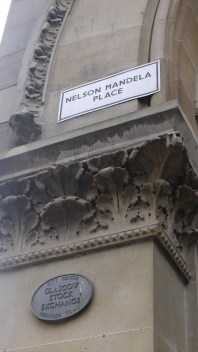
 The Scottish Stockbrokers’ Benevolent Fund’s history dates back many, many years. It is the successor of Benevolent Funds around Scotland, from the days when there were five separate exchanges: Glasgow, Edinburgh, Aberdeen (formed in the 1840s) and Dundee (1879) were never going to be rivalled by the Greenock Exchange (1888). Excepting Greenock’s, the separate cities’ exchanges were merged in 1964, following the Jenkins Committee report, and then in 1971, they rationalised to one trading floor in the Exchange building in Glasgow. At the time this was St George’s Square, but that was renamed in 1986, Nelson Mandela Place.
Technology was relentless, and with quicker communications, and economies of scale, it was not long before the Scottish Stock Exchange closed, trading being absorbed into the London Stock Exchange (1973).
When the exchanges started, you needed to become a member of the exchange in order to trade, but this structure eventually gave way to proprietors, members and clerks. The abolition of fixed commissions, the move to dual capacity, and the advent of computer trading led to the de-regulation of the industry and Big Bang in 1986.
In 1973 the Glasgow Stockbrokers Benevolent Fund, merged with the Edinburgh Stockbrokers Benevolent Fund, and the Glasgow Clerks Benevolent Fund merged with the Edinburgh Clerks Fund. In 1994, the two resulting funds merged too, always with a mission to support present and past members and their families – of the Scottish members and subsequently the Scottish-based LSE members – who fell upon hard times.
Since 1994 there have been no new members of the Scottish or London Stock Exchange but the SSBF continues to award annuities or ex-gratia payments to surviving members and their dependents, and draws new applicants from those who have worked for stockbroking businesses.
 Scottish Stockbrokers' Benevolent Fund