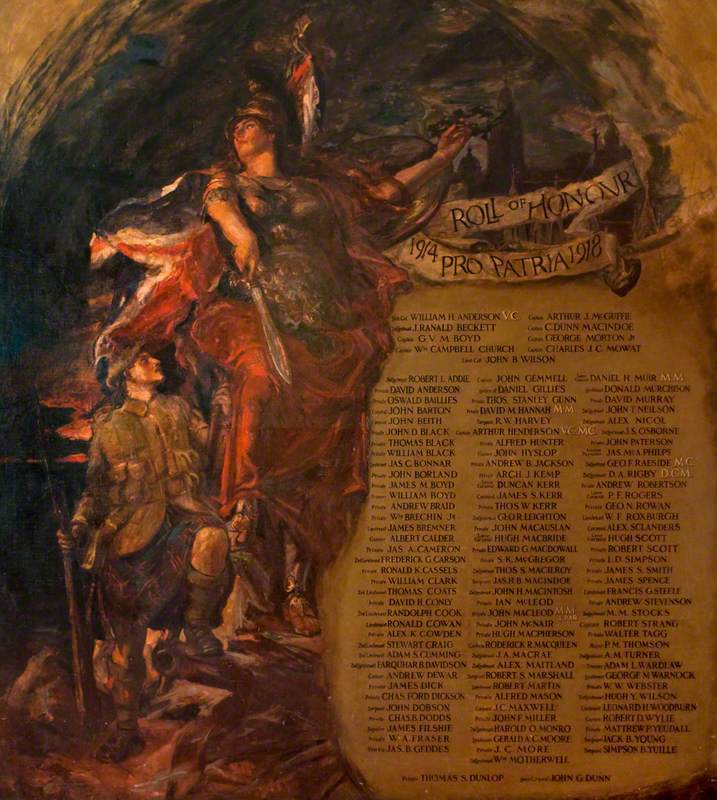
The Glasgow War Memorial (Roll of Honour) pictured here is now found in the Royal Highland Fusiliers Museum in Sauchiehall Street, Glasgow. It is a large oil painting and was previously sited in pride of place, on the stairs of the Stock Exchange Building in Nelson Mandela Place (formerly Stock Exchange Square). The scroll was the work of Mr William Findlay Artist. It was unveiled by Col DW Cameron of Lochiel CMG, and was dedicated by Rev DA Cameron Reid DD MC on April 12 1921.


The Edinburgh Stock Exchange memorials are in the vestibule of St Andrew and St Georges Church on George Street in Edinburgh. They too were originally housed in the Edinburgh Stock Exchange’s offices, but when that closed (1971) they were removed to the Scottish Stock Exchange in Glasgow, but returned to Edinburgh in 1998, to be displayed in their Parish of original location. this is explained on a plaque in the Church.
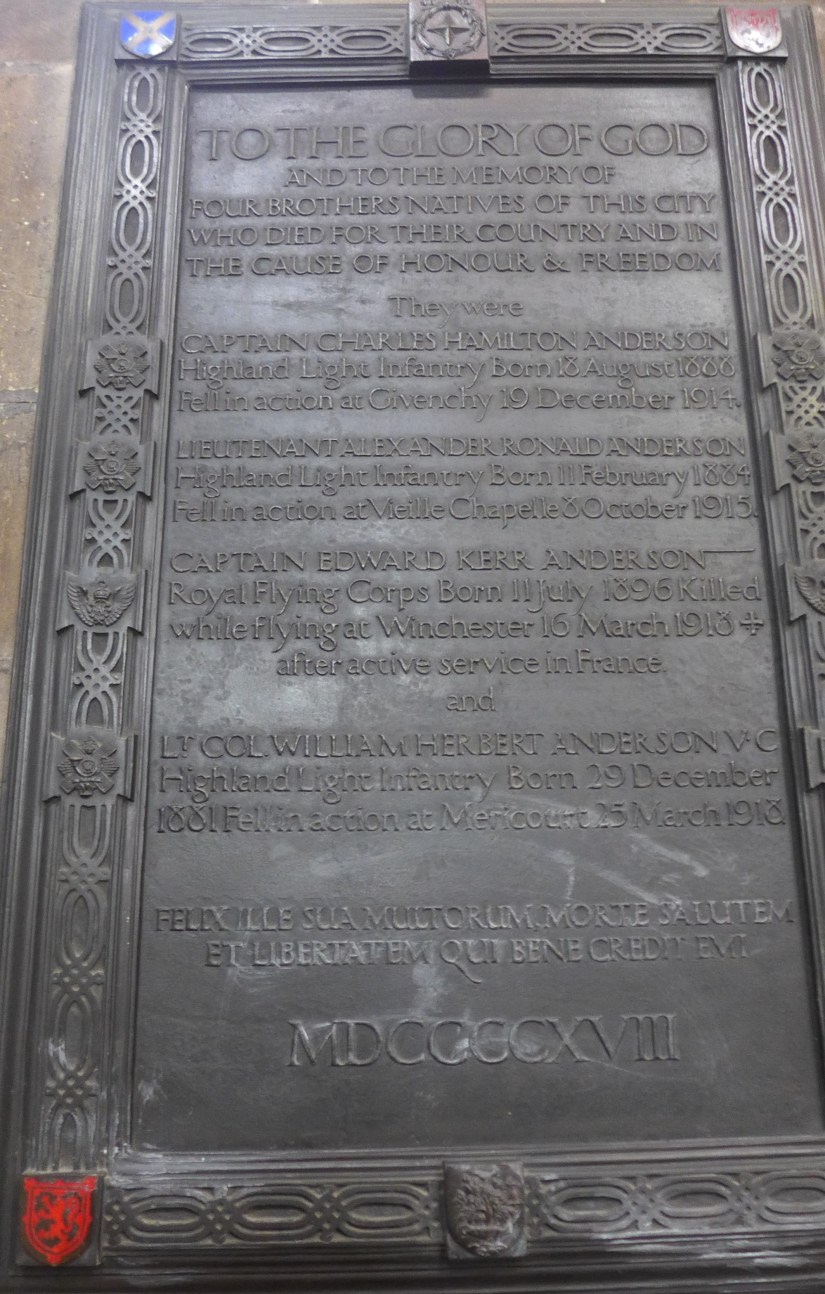
Whilst no one’s sacrifice should be overlooked, we observe that there are two Victoria Crosses mentioned in the Glasgow listing for 1914-18. One is for Capt Arthur Henderson VC MC the other is Lieut-Col William H Anderson VC. There is a further memorial to the latter in Glasgow Cathedral as he was one of four brothers, all of whom were killed during the war. A moving book giving a fictionalised account of this is The Way Home by Robin Scott-Elliot (out of print but available on Amazon as a Kindle download).
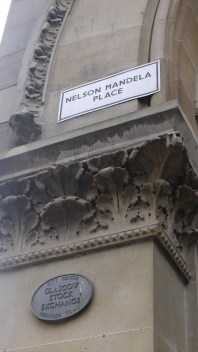 The Scottish Stockbrokers’ Benevolent Fund’s history dates back many, many years. It is the successor of Benevolent Funds around Scotland, from the days when there were five separate exchanges: Glasgow, Edinburgh, Aberdeen (formed in the 1840s) and Dundee (1879) were never going to be rivalled by the Greenock Exchange (1888). Excepting Greenock’s, the separate cities’ exchanges were merged in 1964, following the Jenkins Committee report, and then in 1971, they rationalised to one trading floor in the Exchange building in Glasgow. At the time this was St George’s Square, but that was renamed in 1986, Nelson Mandela Place.
  Scottish Stockbrokers' Benevolent Fund